

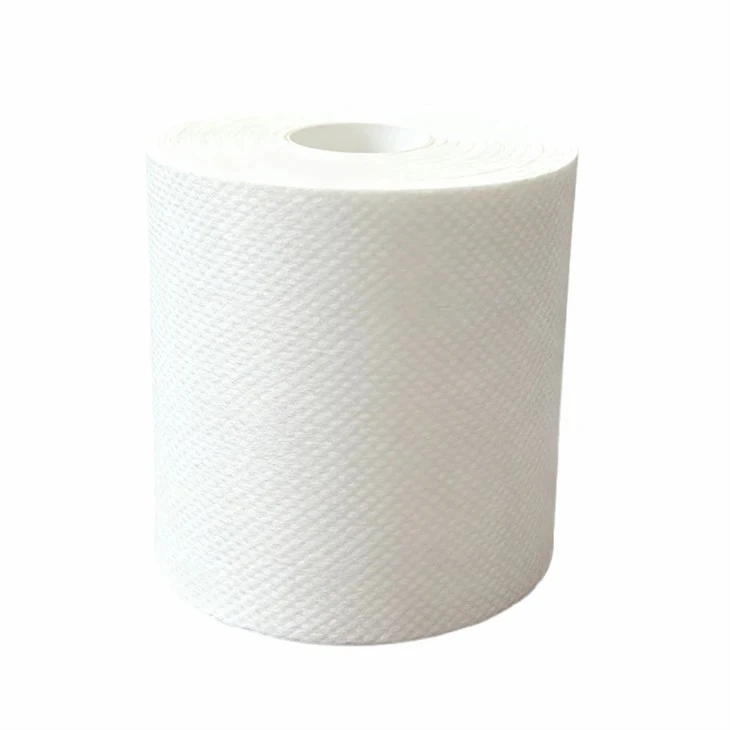
Product Introduction
Industrial Filtration Meltblown Nonwoven Fabric is an engineered microfiber medium manufactured through high-precision extrusion and advanced thermal airflow attenuation using premium thermoplastic polymers. With fiber diameters strictly controlled between 1 and 5 microns, this material forms a dense, three-dimensional interconnected pore network that delivers exceptionally high specific surface area and structural uniformity.
By optimizing the polymer's crystalline molecular weight and leveraging advanced dual-beam manufacturing technology, this industrial-grade meltblown media achieves an optimized balance between maximum fractional particle capture efficiency and ultra-low air resistance (low pressure drop). This optimal aerodynamic performance significantly reduces energy consumption and operational costs in industrial ventilation, dust collection, and HVAC systems. Fully customizable in efficiency grades, mechanical stiffness, and surface treatments, it serves as the core filtration layer in critical environments, including cleanrooms, automotive systems, liquid purification, and oil-water separation.
Product Features
Engineered Microfiber Matrix: Designed for high-probability mechanical particle retention.
Gradient Pore Structure: Ensures high dust holding capacity and an extended filter service life.
Ultra-low Initial Pressure Drop: Minimizes system fan energy consumption while maintaining high airflow.
Excellent Chemical Inertness: Superior resistance to industrial acids, alkalis, and organic solvents.
High-Stability Electret Treatment: Enhanced sub-micron (PM0.3) particle capture via durable electrostatic charging.
Thermal Stability: Optimized for high-speed ultrasonic and hot-melt adhesive lamination.
High Tensile Strength and Stiffness: Prevents deformation, tearing, or delamination during pleating.
Zero Filament Shedding: Completely lint-free material to safeguard downstream sensitive processes.
Technical Specifications
| Item | Specification |
| Product Name | Industrial Filtration Meltblown Nonwoven Fabric |
| Primary Material | 100% Virgin Polypropylene (PP) |
| Basis Weight Range | 15 – 150 gsm (Strict weight tolerance control) |
| Roll Width | 50 – 3200 mm (Custom slitting available, clean and burr-free edges) |
| Thickness | 0.15 – 1.2 mm (Strict tolerance control for automated pleating compatibility) |
| Fiber Diameter | 1 – 5 microns (Typical average) |
| Initial Pressure Drop | 15 – 80 Pa (Customized by efficiency grade; tested at 32 L/min face velocity) |
| Color Options | White / Black / Gray / Custom colors |
| Standard Roll Length | 500 – 3000 meters (Depending on GSM and customer equipment setup) |
| Core Inner Diameter | 3 inches (76 mm) or 2 inches (51 mm) heavy-duty industrial paper tube |
| Surface Treatment | Plain / Electret / Hydrophobic / Hydrophilic |
| Compliance Standards | Compatible with testing protocols: TSI 8130, EN 1822, ISO 16890, ASHRAE 52.2 |
| Regulatory & Safety | RoHS and REACH compliant, 100% silicon-free |
Applications
Commercial and Industrial HVAC: HEPA and ULPA filter media, cleanroom FFU filters, commercial air handling units, pocket or bag air filters, and ASHRAE rated ventilation filters.
Automotive and Machinery: Automotive cabin air filters (including PM2.5 and activated carbon composites), heavy-duty engine intake air filters, and industrial air compressor filters.
Process and Liquid Filtration: Pre-treatment for industrial water purification, chemical solvent filtration, food and beverage processing coarse filters, pharmaceutical filtration, industrial dust collection, and smoke scrubbers.
Manufacturing Process and Quality Control
Process Sequence
Virgin PP Polymeric Resin ➔ Thermal Homogenization and Melting ➔ Precision Die Extrusion ➔ Supersonic Hot Air Attenuation ➔ 3D Microfiber Web Matting ➔ Continuous Calender Thermal Bonding ➔ High-Voltage Corona Electret Charging ➔ Online Laser Gauging and Defect Inspection ➔ Precision Slitting and Center-Winding ➔ Laboratory Quality Control Certification and Safe Packaging
Laboratory Verification Capabilities
To guarantee top-tier industrial performance, our quality control laboratory conducts automated testing on every batch utilizing global standard protocols:
Efficiency and Resistance Testing: Certified via automated filter testers (NaCl and Oil aerosol verification).
Physical Property Profiling: Inspected using digital thickness gauges, precision electronic basis weight balances, and tensile strength testers for absolute structural integrity.
FAQ
Q: What specific filtration standards can this meltblown media achieve?
A: This media can be custom-engineered to meet various global standards, including MERV 11 to MERV 16 (ASHRAE 52.2), ePM1 / ePM2.5 / ePM10 (ISO 16890), and EPA/HEPA grades E11, H12, to H13 (EN 1822). The GSM and electret levels are meticulously balanced to match your target pressure drop.
Q: How does the fabric behave during high-temperature laminating processes?
A: The material is produced from premium narrow-molecular-weight polypropylene which provides a highly stable thermal melting window. The fabric exhibits minimal thermal shrinkage and excellent interfacial bonding strength when combined with spunbond (PP), needle punch, or fiberglass mesh via ultrasonic welding or EVA/PUR hot-melt adhesives.
Q: Is this material safe for sensitive applications like food processing, pharmaceutical, or electronic cleanrooms?
A: Yes, absolutely. The material is made from 100% virgin PP without any recycled content. It is fully RoHS and REACH compliant, 100% silicon-free, and does not shed fibers or outgas organic compounds. This makes it ideal for high-purity cleanrooms and regulated secondary processes.
Q: What support is offered for new product development and engineering qualification?
A: A fast-track sample service is available providing 20 to 50 meter prototype rolls for your engineering qualification and trial pleating runs. Additionally, all bulk orders are delivered with a full technical data package including a detailed Technical Data Sheet (TDS), Material Safety Data Sheet (MSDS), and a Certificate of Analysis (COA) per batch.
Q: What is the standard lead time and global delivery capability?
A: Standard lead time is 7 to 15 days depending on the volume and customization specifications. Orders are shipped with robust global export support, featuring seaworthy pallet packaging (PE wrapping film and moisture-proof protection) experienced in fast-track international customs clearance.


